
Exciting tech is rare
Exhausted with the hype cycle

Professionally I am a developer. Most days I write code, architecht how code should be organised, and plan how new features in my projects should be implemented. Needless to say, my life largely revolves around technology. So why is it when I think about the most talked about waves in technology for the last ~10 years, I’m not excited and barely interested in almost any of it? Friends and colleagues have been surprised by me before when I state no interest in some hot new item that is available to the public or that I have no intention of getting something that they are excited for. Yet even amongst the people around me I have noted that talk of new tech has noticably diminished.
New Technology
Seeing innovation should be exciting. Most of us remember the excitement and interest when the first iPhone came to the market, and I remember the wonder and excitement that came with a new console generation both when the Playstation 2 and Playstation 3 came out. Yet it felt almost non-noticable when the Playstation 5 started hitting store shelves and holiday wishlists.
That is not to say that new technologies with a lot of public excitement isn’t around. The current AI bubble1 is pretty much unavoidable and every single goddam. c-suite manager is frothing at the mouth to proselytize the incredible revolution that generative AI is about to wreak upon everything. Meanwhile there are physical pieces of tech in the augmented reality (AR) and virtual reality (VR) space which is comonly refered to with the intuitive and easily understandable name XR coming out and grabing a fair amount of headlines.

Innovation
Refinement or same but with a higher number is rarely exciting and has a hard time grabbing any notable amount of attention2 . Thinking back on some of the biggest innovations of my lifetime there is a through-line of new form factors and new ways to interact through it. The internet did make information publicly available unlike anything before it, Mobile phones made communication portable, Smartphones changed what we expected from our phones and how we interacted with them.
Something being innovative is not always apparent when it initially comes out though. The internet started in its nascent forms in the late 1960’s and 70’s though it didn’t achieve its mass popularity and associated bubble until the 90’s3 . Though this is more of an illustration of the fact that most technologies are the results of multiple sources of innovation coming together to form something that in itself is innovative.

The Hype Cycle
Looking back through the years there are buckets of articles on various “breakthrough“ technologies that pundits all over the world talk about. Who doesn’t remember blockchain, the internet of things, 3D movies, and the metaverse? All of those were new technologies that garnered a lot of attention but ultimately have gone nowhere though there is a chance for them to be an aspect of future breakthroughs4 just like the other innovations like ARPANET. And this initial hype followed by silence has been identified before
in 1995, Gartner analyst Jackie Fenn identified a common pattern amongst emerging tech which she referred to as the “hype cycle“. it is a rough chart to illustrate public perception of emerging technologies and goes a long way to explain patterns in discussions of tech. Usually when new technologies come out there is an initial wave of excitement over the product which has a tendency to set expectations high. Which of course when the tech fails to live up to those inflated expectations results in a more general distaste or downturn in enthusiasm. eventually though as it matures, the real world use cases of the tech starts to emerge and eventually reaches a stability point
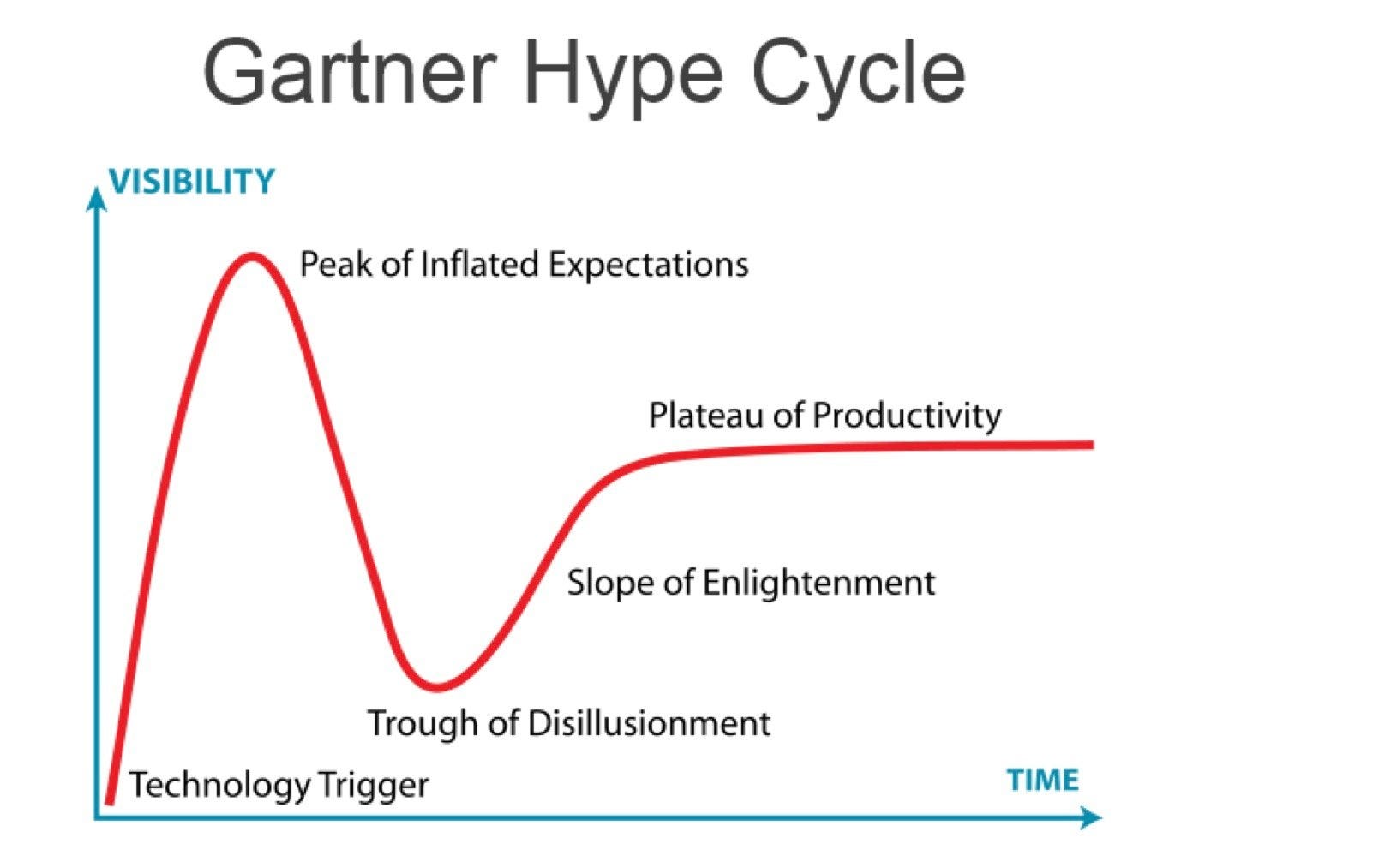
While it is not an exact science I am fairly confident in claiming that this chart and cycle has been a fairly accurate representation of how most if not all technologies have fared.
Now that we are aware of the hype cycle, it would be normal to try and skip through steps 2 and 3 of it so that we can evaluate new technological innovations more level headedly so that we know wether to be exited or not.
Solving Problems
Now the first criteria for new tech that I always consider is “what problem does this solve?“. While it is not always obvious what problem is being solved it is almost always amongst the first thing mentioned mentioned when innovations are being introduced. Innovations that genuinely solve a problem have always been adopted at large scale near instantly. The smartphone allowed people to conveniently access the internet and connect wherever they might be and as such was incredibly popular since initial release and has remained popular. Though for the criteria to make real sense we have to define what solving a problem looks like.
A problem is either something that cannot be done or an inconvenience which either takes up effort or creates a difficult task. The dishwasher is a great example of a problem solver that takes on the inconvenient task of doing the dishes. It does create a new problem (loading the dishwasher), but that problem is minimal by comparison. Solving a problem is often either replacing or significantly shortening a task. Another way to solve a problem is by identifying and removing a problem. Being lost in a city with no idea where to go is certainly a problem. But it is now pretty much nonexistent thanks to smartphones and map applications. Sometimes the problems are not obvious, but I think we can all agree that a solution without a problem is fairly useless.
A new good experience
For something to grab attention one of the key things it must be is “NEW”. That means it must have a method of interaction or an aspect of its experience be completely unlike the status quo. When the iPhone first launched, all phones had buttons. That was how you expected to interact with practically anything. For your phone to act more like a portable mini-computer where the screen itself was the interaction surface was fairly innovative at the time. There was a lot of experimentation, hesitation, and excitement that eventually became how we expect phones to look and behave now. Thinking of it, when was the last time you did an actual phone-call to someone you know on a mobile phone? I don’t think I’ve done that in this decade.
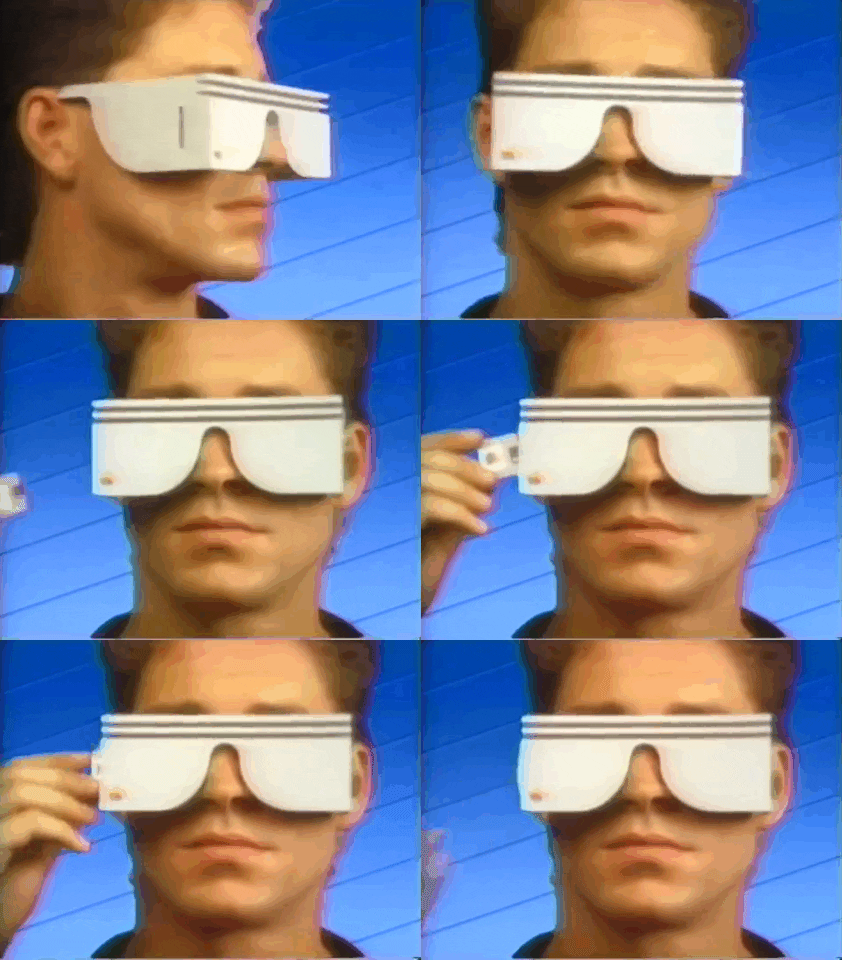
What is important though for technology to actually be exciting in practice rather than theory is for it to be a good user experience. back in 2013 Goggle released “Google Glass“ and while it did get a lot of media attention, the reception was overwhelmingly negative. There were too many drawbacks to justify the advertised advantages (ugly as hell, limited software, creep factor) so it got relegated to the pile of interesting tech that no one wanted. Though like mentioned before, the concept seems to be getting somewhat of a second wind through Meta’s “smart glasses“
By those two principles I do think it is possible to get a jump start on the cycle. Stopping to have a thought or two about any piece of technology which is presented before you is in my opinion a healthy way to evaluate if new tech is something to get excited about
Why hasn’t the latest tech interested me?
The unavoidable elephant in the room here is generative AI5 which to many peoples surprise I am not interested in. It’s not that I haven’t tried and been impressed by aspects of Generative AI . I’ve made quick prototypes or boilerplate code using it and feel like it saved me some time (data disagrees though). But it has the intrinsic problem of hallucinations, and the output while usually fine, is never great (again I think this is intrinsic to how the thing works). It hasn’t stopped companies from crowbarring generative AI into their products everywhere they can (often when it doesn’t even make sense). This incessant pushing of technology that I have tried and don’t want to use does mean that now rather than being curious when I hear anything has Generative AI I now pre-emptively don’t like it on instinct. Needless to say I have seen enough “AI products” that were ultimately garbage to justify this view
This sense of pre-emptively not liking perhaps began when “SMART“ homes and the “Internet Of Things“ started. Smartphones and decreased hardware costs enabled companies to add internet connectivity to their products. In theory, adding computers and sensors to more devices in the home should make our lives better and solve a wide array of problems. And while I really like my robot vacuum cleaner, I am fed up with the amount of apps that every manufacturer makes you install to control the devices, which then either don’t solve any problems or create new problems. The most annoying to me have been “smart“ lightbulbs. Installing an app to control the lights is in my opinion ridiculous. It would not annoy me if they did not rely on the light switch constantly being on (“smart“ switches are sold separately of course). I am not against having a switch on for them, but an app on my phone is not an alternative when I am standing next to the switch, and shouting to some home assistant device potentially sitting in another room is the most ridiculous method of controlling anything that has been marketed towards me (I have a separate related rant for “smart“ assistants). I have seen so many ridiculous “smart“ devices that I consider the term an ironic joke.
Looking over it a lot of those newer technologies seem to have a common aspect of either not solving a problem or worse create more problems than they solve.
New tech I am Excited for
First of I love VR! It’s a new-ish way to fully immerse yourself in an interactive experience and allows for some really interesting methods of interaction. VR is often Bundled with AR under the monicker XR, but I hate to admit that I a just luke-warm on AR. Will it become mainstream or something that everyone has? I doubt it, personally I suspect that VR will become a sizeable and consistent niche. I just hope that it becomes sizeable and consistent enough to warrant more development in the space
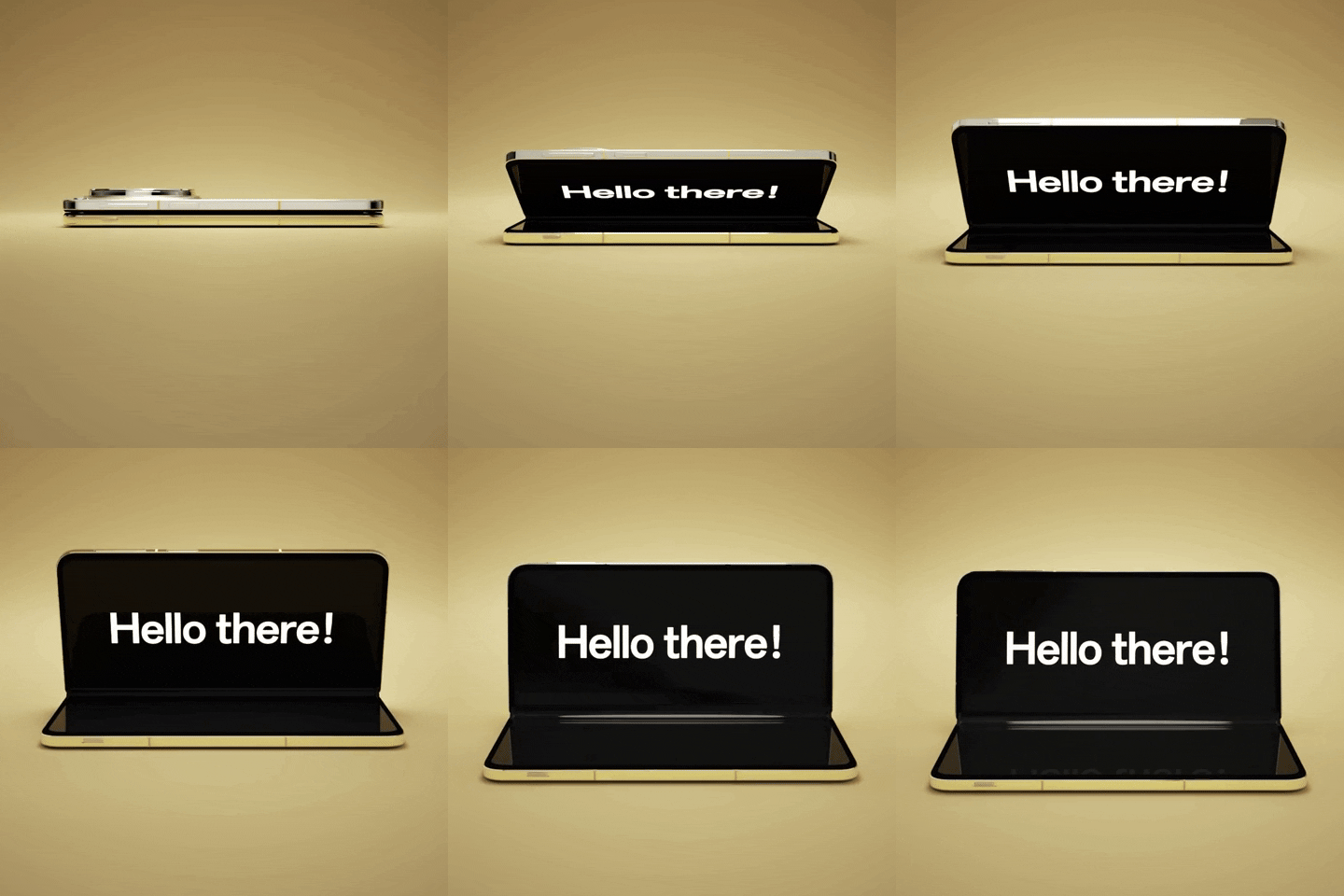
Foldable phones are in my opinion awesome. They are superficially solving the issue of the average phone, that everyone has in their pocket, being comparatively small so they are not a good way to do anything but quick actions. In my opinion normal smartphones are awful to watch any video that’s longer than ~10 minutes. To have a larger screen available has changed how I interact with my phone. When I open up to the bigger screen it is for a task, then the front becomes where I check quick messages or notifications before the phone goes back in my pocket. Echoing my theme from last year I am using the phone less, but getting more from it as well when I need or want it.
3D printers do solve a huge problem by allowing you to print out the small things you would otherwise have go to a store for or are otherwise not available. Though I think they’re held back largely by their slow print speeds, noise, and maintenance. Though none of there issue feel insurmountable and a decent affordable version should not be an impossibility
Honestly this has been a meandering thing to write but I guess putting down in text my feelings towards the latest trends in tech was therapeutic for me, and hopefully an enjoyable read.
Anyone claiming it isn’t a bubble is either not paying attention or a blithering idiot
[Finance mogul] https://www.msn.com/en-us/money/savingandinvesting/ray-dalio-says-ai-is-in-the-early-stages-of-a-bubble-so-watch-out-for-2026/ar-AA1TH9EA
[AI ceo] https://www.cnbc.com/2025/08/18/openai-sam-altman-warns-ai-market-is-in-a-bubble.html
[business reporter/analyst] https://www.wheresyoured.at
unless the increase in numbers brings something meaningfully different (see the change to HD screens)
I’ll buy and eat a hat if blockchain becomes something that everyone is using. And no I won’t expand on this, I won’t argue with crypto fans (most consistently annoying people on the globe behind door-to-door salesmen)
The GENERATIVE part is important! Artificial intelligence is a wide subject and generative AI is just one branch that spawned out of machine learning